November 3 School Bond Proposal
What Would It Cost?
A Look at Property Taxes, Bond Financing and Spending Safeguards
Part 4 of a six-part series on the Gordon-Rushville Public Schools bond proposal
GORDON, Neb. — October 16, 2026 — For the owner of a $100,000 home, the $24.85 million Gordon-Rushville Public Schools bond proposal on the Nov. 3 ballot would mean an estimated $162 a year in additional property taxes, or $13.50 a month.
Farmers and ranchers would also see an increase, although the amount would depend on the county, land classification, and assessed valuation of their property.
The district estimates the bond would add 16.2 cents per $100 of taxable valuation to its current school levy of 68.1 cents, bringing the total to approximately 84.3 cents. The additional revenue would be used to repay bonds issued to finance construction and renovations at the district's high school in Gordon and to add an elementary school onto the middle school in Rushville.
The proposal would replace the high school's original three-story building, now approximately 100 years old, with a modern addition. In Rushville, a new elementary addition would connect to the existing middle school, allowing the district to discontinue use of the current elementary building. The project also includes safety improvements, renovations, and replacement of the track in Gordon.
Voters are being asked to authorize borrowing of up to $24,850,000, with repayment currently estimated over 25 years.
What homeowners would pay
Residential property taxes would increase based on the taxable value of each home. The district provided the following examples:
Estimated Residential Tax Impact
Home valuation | Annual increase | Monthly increase |
$100,000 | $162 | $13.50 |
$250,000 | $405 | $33.75 |
$500,000 | $810 | $67.50 |
The median home value in Gordon and Rushville is estimated to be just under $100,000, which means half of the homes would pay less than $162 a year and half would pay more.
These figures represent only the additional taxes associated with the proposed bond, not a homeowner's total school property-tax bill. Actual amounts could vary depending on future valuations, interest rates, and other factors.
Property owners can enter their own valuation into an online calculator at GRbond.org to estimate the additional cost.
How the bond would affect farmers and ranchers
Agricultural land is treated differently from residential property when calculating taxes for voter-approved school bonds.
Under Nebraska law, agricultural and horticultural land is valued at 50% of its actual value for these bonds, compared with the 75% generally used for other property-tax purposes. The provision reduces the taxable value of farmland and ranchland for bond repayment.
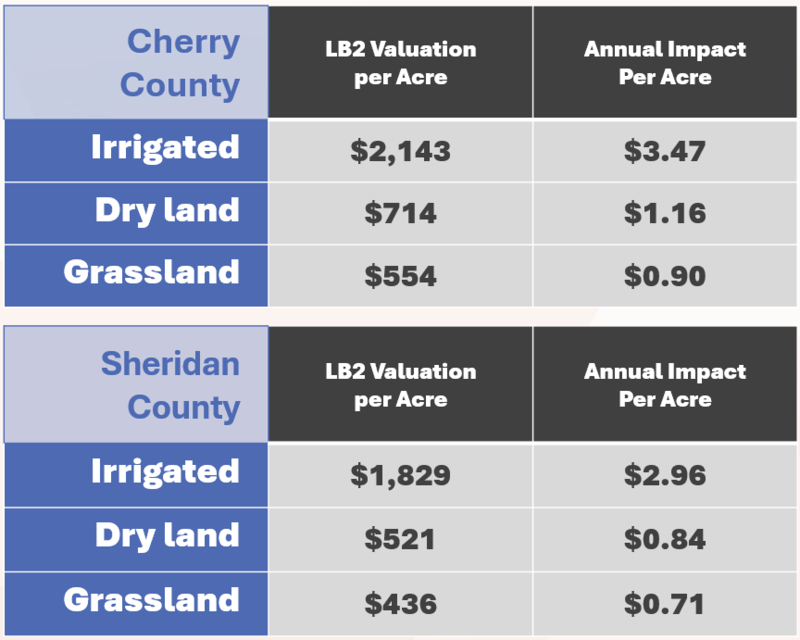
The district's estimates illustrate how the impact varies between Cherry and Sheridan counties and among irrigated cropland, dryland and grassland.
Estimated Annual Agricultural Land Tax Impact
Land classification | Cherry County per acre | Sheridan County per acre |
Irrigated (1A1) | $3.47 | $2.96 |
Dryland (1D1) | $1.16 | $0.84 |
Grassland (1G1) | $0.90 | $0.71 |
The district's estimates are based on agricultural land valuations ranging from $1,829 to $2,143 per acre for irrigated land, $521 to $714 for dryland, and $436 to $554 for grassland, depending on the county.
For example, a rancher with 1,000 acres of Sheridan County grassland assessed in the 1G1 category would pay an estimated additional $710 annually.
Individual amounts will vary based on the assessed value and classification of each parcel.
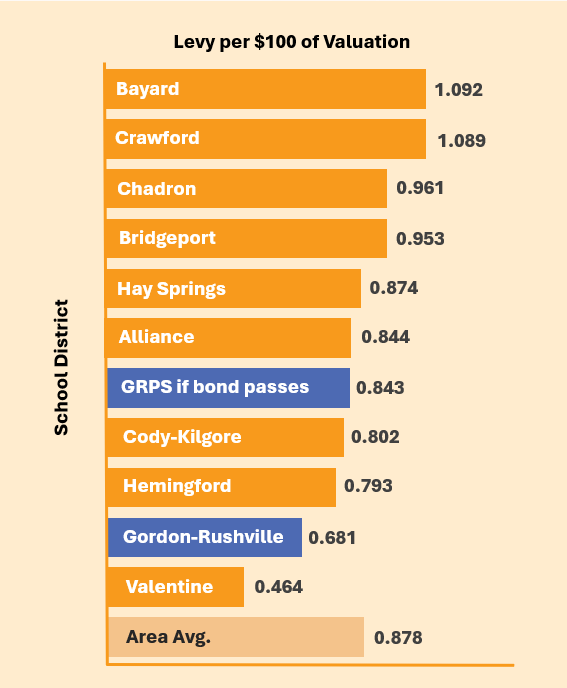
How does Gordon-Rushville's levy compare?
Gordon-Rushville currently has the second-lowest school levy among the 10 area districts included in its comparison.
Its existing levy is 68.1 cents per $100 of taxable valuation. With the proposed bond, that would increase to approximately 84.3 cents.
That projected rate would remain below six of the other nine districts in the comparison and below the 10-district average of 87.8 cents.
Why the bond isn't on the pink postcards
Property owners in the district recently received pink postcards identifying local governments proposing certain increases in their property-tax requests.
Those notices concern annual tax requests and related public hearings. GRPS did not meet the threshold requiring its inclusion in those notices for its current property-tax request.
The proposed school bond is a separate question that has not yet been decided by voters.
How the bonds would be financed
If voters approve the measure, the district would be authorized to issue general obligation bonds in an amount not exceeding $24,850,000. Property taxes collected within the district would be used to repay the principal and interest.
The district's current financial projections assume a 25-year repayment period, with a levy increase of approximately 16.2 cents per $100 of taxable valuation.
The actual interest rate would not be established until the bonds are sold. D.A. Davidson, the district's financial advisor, is assisting with the financing projections.
The ballot language allows the Board of Education to determine when bonds are issued, the interest rates and their repayment schedule. The district would not be required to borrow the entire authorized amount.
Depending on interest rates and other market conditions, the district could have an opportunity to refinance outstanding bonds at a lower rate or retire some debt early. Either could reduce future borrowing costs, although neither outcome is guaranteed.
What safeguards are in place for spending?
The $24.85 million figure is a maximum borrowing authorization, not a requirement to spend that amount.
BD Construction of Kearney, selected by the district as its construction manager, and the architect, JEO Consulting, developed the bond amount using the proposed building designs and current and historical costs from comparable school construction projects.
The amount includes contingencies for unexpected conditions as well as design and construction costs. If contingency funds aren't needed, they won't be spent or billed.
The project is currently in schematic design, meaning more detailed construction drawings and cost estimates will be developed if the bond is approved. The individual divisions of construction work would then be competitively bid.
The district's building committee will review bids and costs as the project advances.
How much could waiting cost?
Construction costs are another factor district officials have discussed during the planning process.
District officials have used approximately 5% annual construction cost inflation as a planning estimate, while participants in public meetings discussed potential increases ranging from 5% to 7%.
At a 5% annual increase, a project costing $24.85 million today would cost approximately $26.09 million one year later, assuming the same scope and no other changes.
After three years, that same project would cost approximately $28.77 million.
Those figures are illustrations, not construction bids or predictions. Actual costs will depend on materials, labor, market conditions and the final project design.
District officials say aging building systems would continue to require maintenance and repairs regardless of whether the bond passes.
Operating savings would be separate from bond payments
While the proposed bond would increase property taxes, district officials estimate the completed project would reduce annual operating expenses by approximately $213,000.
As described in last week's article, the plan would reduce the district's overall building space by more than 19,000 square feet and consolidate its four current school buildings into three.
The district estimates approximately $127,500 in annual savings from staffing and operational efficiencies and another $85,500 from reduced building maintenance and related costs.
The high school would decrease from approximately 85,000 square feet to 71,285 square feet. In Rushville, the proposed elementary addition would be nearly 6,000 square feet smaller than the existing elementary school.
Maintaining less space is expected to reduce expenses for heating, cooling, cleaning and repairs.