
Bond Questions, Answered
Answers to the questions residents have asked most often about the Gordon-Rushville Public Schools bond proposal
Part 5 of a six-part series on the Gordon-Rushville Public Schools bond proposal
GORDON, Neb. — October 23, 2026 — Since the Board of Education called a bond election in August, residents have asked questions at community meetings, through GRbond.org and in conversations with staff and board members. This article, the fifth in a six-part series, answers the questions the district has heard most often about the $24.85 million bond proposal on the Nov. 3 ballot.
About the plan
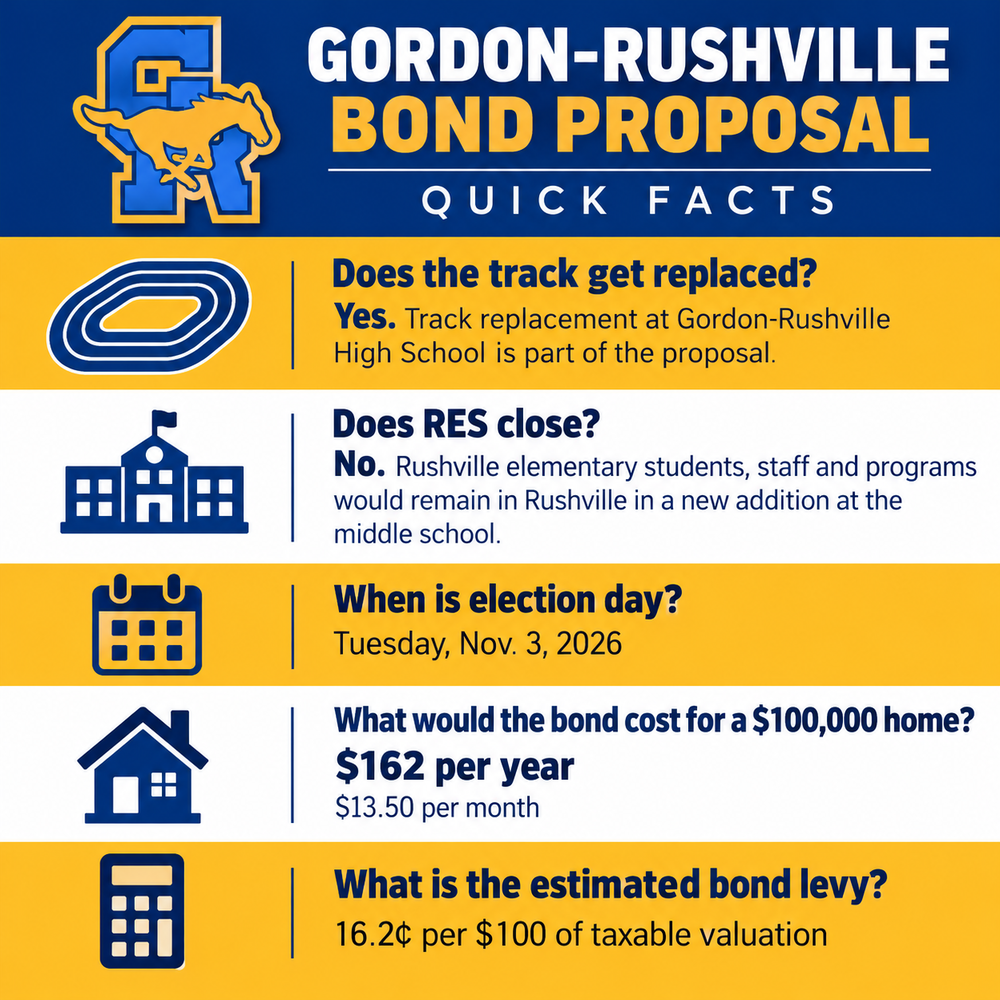
Is the track included in the bond?
Yes. Replacing the track at Gordon-Rushville High School is part of the project. The district has been advised not to use the existing track.
Why is the district building additions instead of renovating its existing buildings?
Both renovation and replacement were evaluated during planning. The district considered building conditions, construction costs and long-term use.
For example, an early concept that retained and renovated the original three-story high school was estimated at $23.8 million to $28.6 million. A comparable concept replacing that portion was estimated at $20.7 million to $24.8 million. These were preliminary alternatives, not final project estimates.
The independent facility assessment also identified accessibility concerns, aging building systems and other deficiencies in the oldest facilities.
In Rushville, renovation of the current elementary school would not provide a cafeteria or gymnasium, so students would continue crossing the street for those activities.
Under the proposed construction plan, students would remain in their current classrooms while the additions are built, reducing the need and expense of temporary classroom space.
Enrollment is declining. Why does the district need new space?
The proposal would reduce the amount of space the district maintains, not add to it. Gordon-Rushville enrolled more than 800 students when the district was formed in 2006 and serves about 500 today. Even so, it ranks 87th in size among Nebraska’s 244 public school districts, according to 2025–26 Nebraska Department of Education data.
Lower enrollment does not eliminate the need for classrooms, cafeterias, offices and specialized instructional space, but it did lead the district to ask whether it still needed four separate school buildings. Under the proposal, the district would operate three school buildings instead of four and maintain more than 19,000 fewer square feet. The high school would shrink from about 85,000 square feet to 71,285, and the Rushville elementary addition would be nearly 6,000 square feet smaller than the current elementary building.
About Rushville
Is Rushville Elementary closing?
No. Rushville Elementary would not close. Its students, teachers and programs would stay in Rushville, in a new addition built onto Gordon-Rushville Middle School across the street from the building they use today. The elementary and middle school would each have their own secure entrance, and elementary students would no longer cross the street for lunch or physical education.
What will happen to the current Rushville Elementary building?
After students move into the new addition, the Board of Education would seek a buyer for the current building. The district hopes to move some of the existing playground equipment next to the new addition.
About staff and operating costs
Would the project reduce operating costs?
The district estimates the completed project would reduce operating costs by at least $213,000 a year:
• Staffing, about $127,500 a year: a half-time administrative position ($67,500) and one custodial position ($60,000)
• Heating and cooling, about $28,500 a year: based on a Nebraska average of $1.50 per square foot for the 19,000 square feet the district would no longer maintain
• Repairs and maintenance, about $57,000 a year: based on $3 per square foot, within an estimated range of $2.50 to $4
If the district were able to reduce its property-tax request by $213,000 a year, it estimates the savings would total about $8.3 million over the 25-year life of the bond, assuming 3.5% annual inflation. The district describes these as minimum estimates; they do not include possible savings in the space that would be kept and renovated. Operating savings are separate from the bond payments, which would be repaid through the bond levy.
Will teachers or other staff lose their jobs?
The district’s savings estimate includes absorbing a half-time administrative position and one custodial position. It does not include any reduction in teaching positions.
About cost and taxes
How would the bond affect agricultural landowners?
Under Nebraska law, agricultural and horticultural land is valued at 50% of its actual value for taxes used to repay voter-approved school bonds, rather than the 75% generally used for other property taxes. Estimated annual impacts per acre are $3.47 for irrigated land, $1.16 for dryland and $0.90 for grassland in Cherry County, and $2.96, $0.84 and $0.71 in Sheridan County. An owner of 1,000 acres of Sheridan County grassland in the 1G1 classification, for example, would pay an estimated $710 more a year.
How can we be sure the project can be built for the bond amount?
BD Construction and JEO developed the bond amount using the proposed designs and current and historical costs from comparable school projects in the region. The amount includes design, construction, inflation and contingency. If the bond passes, every division of construction work would be competitively bid, and the district’s building committee would review bids and costs. The district cannot borrow more than $24,850,000.
What happens to bond funds that aren’t spent?
The district is not required to borrow the full $24.85 million, and the Board of Education decides when bonds are issued. Contingency funds that aren’t needed won’t be spent or billed.
Why not wait until interest rates or commodity prices improve?
Construction costs generally rise over time. District officials have used 5% annual construction-cost inflation as a planning estimate. At that rate, a project that costs $24.85 million today would cost about $28.77 million in three years, assuming the same scope. These figures are illustrations, not predictions. Most school bonds are refinanced at some point if rates fall.
Will local contractors be able to bid on the work?
If the bond passes, BD Construction would competitively bid each division of work to subcontractors once detailed design is complete.
About the process and timing
How was the proposal developed, and what happens next?
Facility planning began in 2023 with staff surveys, followed by a draft five-year facilities plan in 2024 and an independent assessment in 2025. Public meetings, building tours, work sessions and surveys continued through 2026, with the district receiving 576 responses across its community and staff feedback efforts.
The proposal evolved in response to community feedback. An early concept for a new K–12 facility, estimated at $60 million to $80 million, was eliminated. When community feedback indicated a preference for additions over renovations, the Board of Education adjusted the plan accordingly. A proposed new gymnasium was also removed before the board called the bond election in August.
If voters approve the bond, detailed design would begin after the election, with construction expected to start in spring 2027 and completion targeted for fall 2028. Students would remain in their current classrooms until the new additions are ready.
If the bond is not approved, the district would continue maintaining and repairing its existing facilities, including the aging building systems identified in the facility assessment.
Have another question?
Questions may be submitted at GRbond.org or directed to the district office at 308.282.1322. Concept drawings, the property-tax calculator and earlier articles in this series are also available on the website.